
How to Scale Ecommerce Ads Without Killing ROAS
Summary: Scaling ecommerce ads without killing ROAS isn’t about increasing budgets carelessly. It is about understanding marginal acquisition cost, contribution margin, creative fatigue, and funnel readiness. If you scale spend before strengthening these foundations, ROAS will drop.
Most ecommerce brands reach a point where ads are profitable at a certain budget level. Then they try to scale. Spend increases, conversions rise briefly, and ROAS starts declining.
Scaling ecommerce ads is not just about pushing more money into campaigns. It is about protecting profitability while expanding reach. The difference between smart scaling and reckless scaling lies in understanding how platforms work under pressure.
Why ROAS Drops When You Scale Ecommerce Ads?
Before discussing tactics, it is important to understand why ROAS typically declines as scaling progresses.
The Marginal Cost Curve in Ecommerce Advertising
Your first customers are usually the cheapest to acquire. Platforms prioritize the most responsive audiences first. As you increase the budget, the algorithm expands into less efficient segments.
This is called marginal acquisition cost. The next batch of customers always costs more than the previous batch. When brands ignore this curve, they assume performance should remain constant as spend increases. It rarely does.
Audience Saturation and Signal Dilution
As the budget increases, frequency rises. Audiences become saturated. Creative fatigue accelerates. Performance declines not because ads are bad, but because exposure is too high for the same pool of users.
Scaling ecommerce ads without expanding signal quality leads to dilution. You are asking the system to find more buyers with the same data.
Scaling Before Funnel Readiness
Many brands try to scale ads while product pages, checkout flow, and average order value remain weak. When traffic increases, but the conversion rate does not improve, ROAS drops.
Ad scaling magnifies existing weaknesses in your ecommerce funnel.
The 3 Types of Ecommerce Ads Scaling
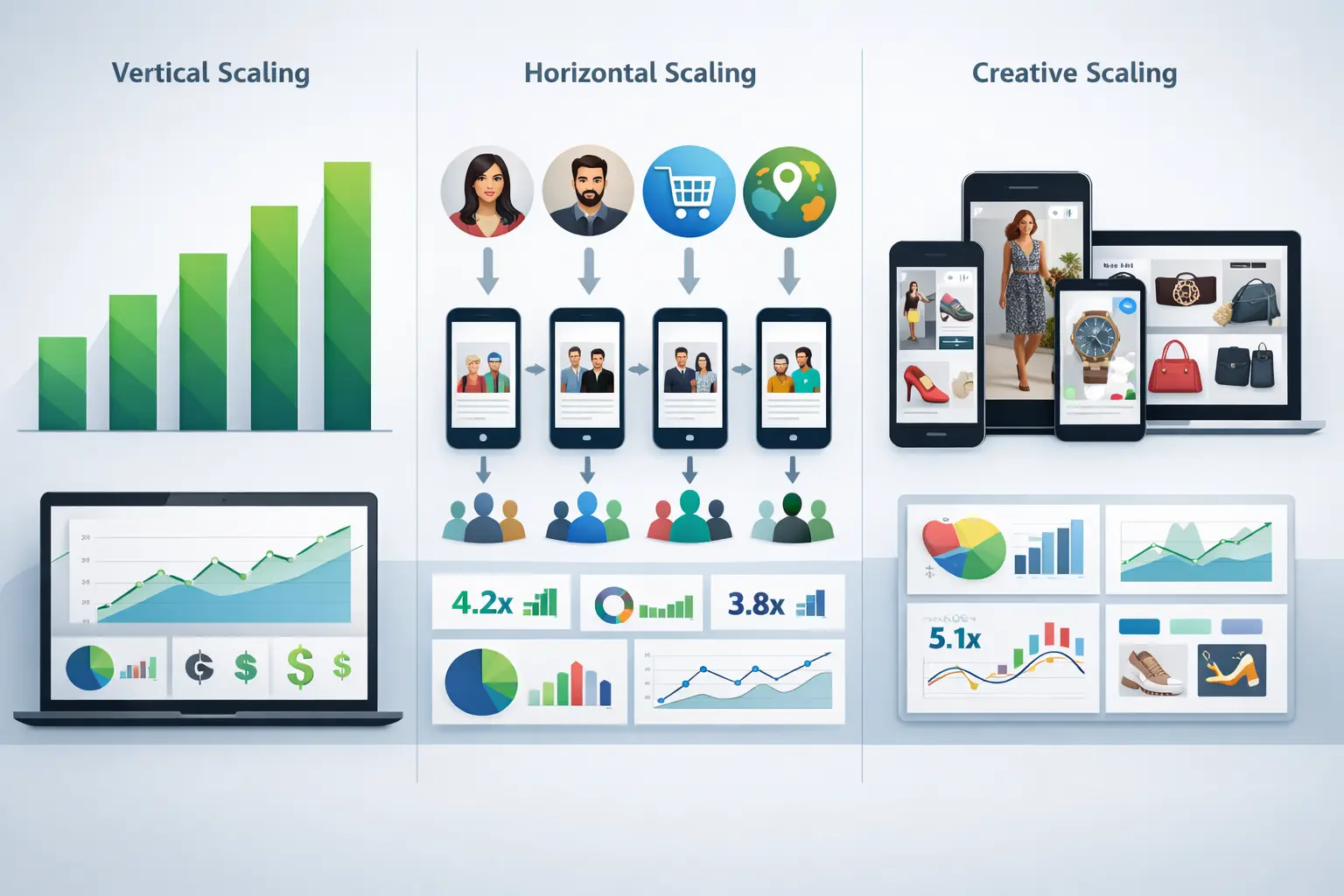
Scaling paid ads profitably requires understanding the different approaches available.
-
Vertical Scaling in Ecommerce Ads
Vertical scaling means increasing budgets within existing campaigns. This is where the common advice of increasing spending gradually comes from.
Gradual increases allow algorithms to adapt. However, vertical scaling works best when campaigns already have strong signal density and consistent conversion volume.
-
Horizontal Scaling in Ecommerce Ads
Horizontal scaling involves duplicating winning campaigns and expanding into new audiences. This includes broader targeting, higher percentage lookalikes, or new geographies.
This approach spreads risk and reduces audience saturation. It also helps maintain a more stable ROAS than aggressive vertical scaling.
-
Creative Scaling Strategy
Creative is often the true scaling lever. When budgets rise, existing ads fatigue faster. Without new hooks, angles, and formats, frequency increases and performance drops.
Creative scaling means consistently testing new concepts. It is not just about swapping images. It is about evolving messaging as audience size expands.
Break-Even ROAS and Contribution Margin Before You Scale
Scaling ecommerce ads without understanding your financial thresholds is dangerous.
How to Calculate Break-Even ROAS
Break-even ROAS is calculated by dividing revenue by allowable ad spend. To determine this, you must know your contribution margin.
Contribution margin equals revenue minus the cost of goods sold, shipping, payment processing, and variable expenses. If your margin is 40 percent, your break-even ROAS is 2.5.
Scaling below this threshold means losing money, even if revenue grows.
Why High ROAS Can Still Kill Profit
Some brands maintain high ROAS by using heavy discounts. While this inflates conversion rate, it shrinks margins.
Scaling an unprofitable offer only magnifies losses. Profitability must guide scaling decisions, not vanity metrics.
Signal Density and Data Readiness for Scaling Paid Ads
Scaling ecommerce ads depends more on signal strength than on budget size.
Why You Need Conversion Volume Before Scaling
Ad platforms optimize based on data. If your account generates limited purchase events, the system struggles to expand efficiently.
Accounts with consistent conversion volume scale more smoothly because algorithms have stronger patterns to follow.
First-Party Data and High-Value Lookalikes
Scaling works best when based on high-value customer lists. Creating lookalikes from top-spending customers produces better performance than broad website visitors.
Strong first-party data improves targeting quality and stabilizes ROAS during expansion.
How to Increase Ad Spend Without Lowering ROAS?

Now that foundations are clear, we focus on sustainable scaling methods.
Scaling Through AOV Expansion
If you increase average order value, you can tolerate higher acquisition costs without reducing profitability.
Bundles, tiered pricing, and strategic upsells improve margin flexibility. When AOV increases, acceptable CAC increases as well.
Scaling Through Funnel Optimization
Landing page clarity, product page persuasion, and checkout simplicity increase conversion rate.
Improving funnel performance allows you to scale ecommerce ads while maintaining stronger ROAS because more traffic converts.
Scaling Through Platform Diversification
Relying on a single channel increases risk. Scaling across Meta, Google, and other platforms distributes budget pressure.
Different platforms capture different intent levels. This stabilizes the overall ecommerce advertising strategy.
Warning Signs You Should Not Scale Ecommerce Ads Yet
Scaling at the wrong time accelerates losses.
- If daily conversions fluctuate heavily, your account lacks stability.
- If creatives are already fatigued, scaling will worsen performance.
- If margins are thin, scaling increases financial risk.
- If inventory or cash flow cannot handle higher volume, growth becomes dangerous.
Scaling should follow readiness, not ambition.
A Practical Ecommerce Ads Scaling Checklist
Before increasing the budget, ask:
- Is break-even ROAS clearly calculated?
- Are campaigns stable over a seven-day window?
- Is creative testing consistent?
- Is first-party data strong?
- Can cash flow support higher daily spend for at least 30 days?
If these answers are uncertain, scale cautiously.
Conclusion: Scaling Ecommerce Ads Is a Profit System, Not a Budget Trick
Scaling ecommerce ads without killing ROAS requires more than patience. It requires understanding marginal cost, strengthening conversion systems, and protecting contribution margin.
ROAS drops during scaling are not random. They are predictable outcomes of weak preparation.
At EvenDigit, we help ecommerce brands build structured scaling strategies that combine margin modeling, creative iteration, and funnel optimization. Our focus is on increasing revenue sustainably while protecting profitability.
When scaling becomes a system rather than a gamble, growth stops being volatile and becomes controlled.
Frequently Asked Questions About Scaling Ecommerce Ads
How fast should I scale ecommerce ads?
Most accounts scale safely when budgets increase gradually, and performance remains stable for at least three to five days. Sudden jumps increase volatility and learning instability.
Does scaling always reduce ROAS?
Short-term fluctuations are common. Long-term ROAS stability depends on signal strength, margin flexibility, and creative depth.
What is a safe ROAS before scaling?
ROAS should be comfortably above break-even before scaling. If campaigns are only slightly profitable, scaling increases financial risk.
Can I scale ecommerce ads with low margins?
Low margins require strict contribution analysis and strong AOV strategies. Without margin flexibility, scaling becomes risky.
Should I scale during seasonal spikes?
Seasonality can temporarily improve performance, but scaling during spikes requires caution. Once demand normalizes, ROAS may decline sharply.