Category Page SEO Blueprint for Large Ecommerce Sites
Summary: Category page SEO for large ecommerce sites is not about adding keywords and filters. It is about controlling crawl budget, preventing cannibalization, managing faceted navigation, and building scalable content systems that support both rankings and conversions.
On large ecommerce sites, category pages are often the highest revenue-driving URLs. They target high-intent transactional keywords and distribute authority to hundreds or thousands of product pages.
When category page SEO is poorly structured, crawl budget gets wasted, rankings fluctuate, and duplicate URLs multiply. For enterprise ecommerce brands, category optimization is infrastructure, not a minor SEO task.
Understanding Category Page SEO for Large Ecommerce Sites
Before applying tactics, it is important to understand why ecommerce category page optimization becomes complex at scale.
Why Ecommerce Category Page Optimization Is Different at Scale?
Small ecommerce sites manage dozens of categories. Large ecommerce sites manage thousands. Each category may have multiple filters, pagination layers, regional versions, and seasonal variations.
This creates URL explosions. Without strict governance, search engines crawl unnecessary variations while missing high-value pages.
Category page SEO for large ecommerce sites must balance discoverability with control.
The Role of Category Pages in Ecommerce SEO Strategy?
Category pages target mid-funnel and bottom-funnel queries such as “men’s running shoes” or “wireless headphones under 100.” These queries often convert better than informational content.
Well-optimized categories also strengthen internal linking. They pass authority to product pages and subcategories, helping the entire ecommerce SEO strategy scale.
Ecommerce Site Architecture and Taxonomy Optimization
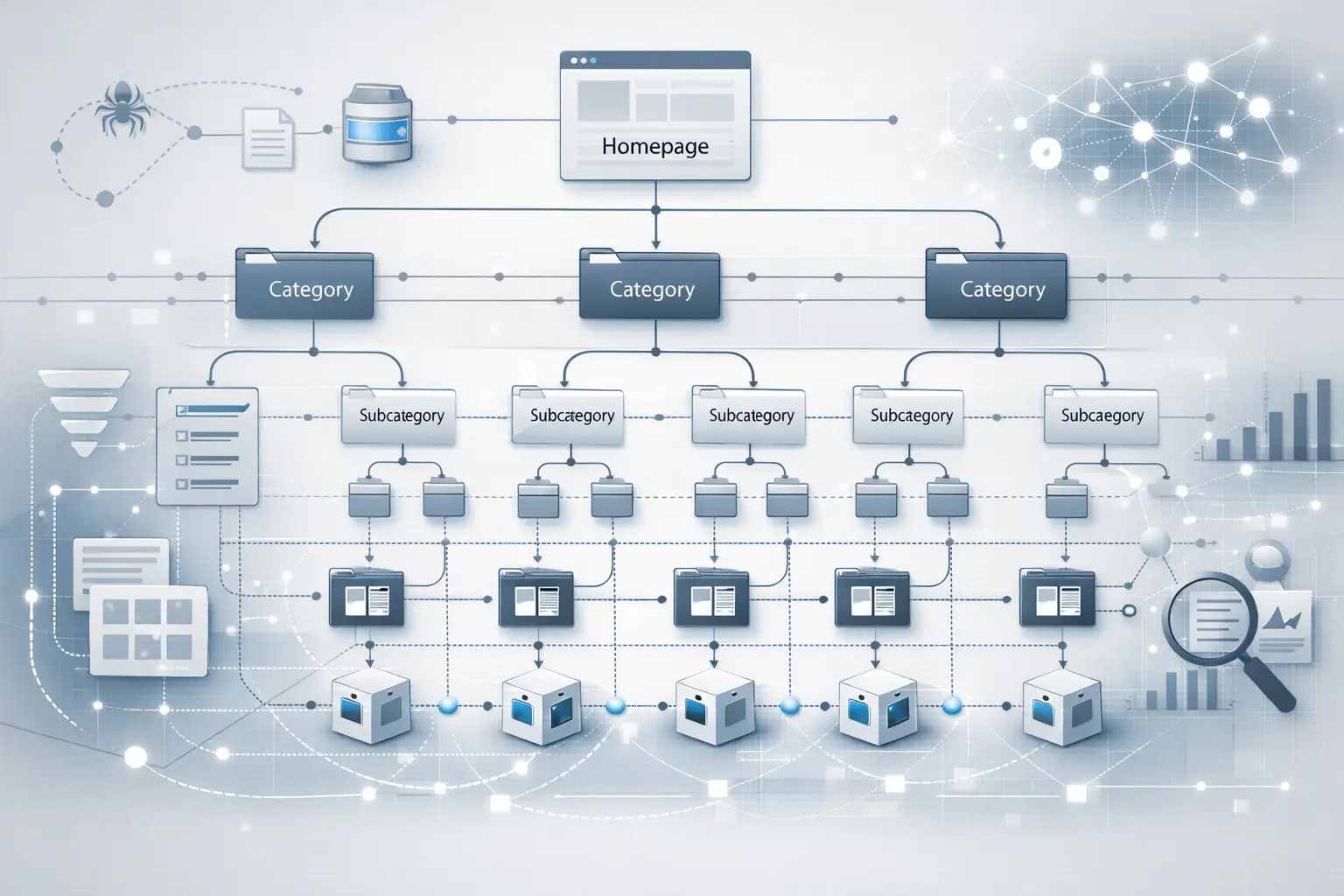
Structure is the backbone of category page SEO.
Building a Logical Hierarchical Structure for Large Ecommerce Sites
A clear taxonomy organizes products from broad to specific. For example:
Home → Electronics → Headphones → Wireless Headphones
This hierarchy helps search engines understand relationships between pages. Clean URLs that reflect this structure improve indexation and clarity.
Avoid flat structures where every category sits at the same level. Large ecommerce sites need depth, but depth must remain logical.
Preventing Keyword Cannibalization Across Categories
Large catalogs often create overlapping categories that compete for the same keyword.
For example, “Running Shoes” and “Sports Shoes” may unintentionally target identical search terms. Without keyword intent mapping, both pages compete against each other.
other.
To prevent cannibalization:
- Assign primary keywords to parent categories.
- Target modifiers and niche intent in subcategories.
- Avoid duplicate optimization across similar URLs.
Each category should have a defined search intent.
Breadcrumbs and Internal Linking for Ecommerce
Breadcrumb navigation reinforces hierarchy. It improves user navigation and provides structured internal linking signals.
Breadcrumb schema also enhances search visibility. For large ecommerce sites, breadcrumbs are essential for maintaining authority flow and contextual relevance.
Crawl Budget Optimization for Large Ecommerce Sites

Crawl budget becomes critical once an ecommerce site scales beyond a few thousand URLs.
Why Crawl Budget Becomes Critical at Scale
Search engines allocate limited crawl resources. If bots spend time crawling filter parameters and duplicate URLs, they may not efficiently discover new products or updated categories.
Large ecommerce sites must actively manage crawl budget optimization.
Faceted Navigation SEO and Parameter Control
Filters for color, size, brand, and price improve user experience but can create thousands of parameter-based URLs.
To control faceted navigation SEO:
- Use canonical tags strategically.
- Noindex non-essential filter combinations.
- Prevent crawlable infinite parameter chains.
- Avoid indexing low-demand filter variations.
Not every filter combination deserves indexation.
Indexation Control and URL Prioritization
Not all category pages should be indexed. Seasonal or low-demand categories may dilute overall authority.
Large ecommerce sites should:
- Monitor index coverage reports.
- Audit thin categories.
- Consolidate overlapping URLs.
- Remove obsolete seasonal categories.
Indexation must be intentional.
Ecommerce Pagination SEO and Infinite Scroll Risks
Pagination impacts both crawlability and user experience.
Crawlable Pagination Best Practices
Pagination should use clear, crawlable links. Avoid hiding deeper pages behind JavaScript-only infinite scroll.
Ensure product links on deeper pages are accessible through structured pagination paths. This prevents orphaned products and ensures full inventory visibility.
Managing Large Product Sets Without Losing Rankings
Very deep pagination layers reduce crawl priority. Important products may remain undiscovered.
To improve ecommerce pagination SEO:
- Feature high-performing products near the top.
- Use internal links from subcategories.
- Limit excessive pagination depth where possible.
Balance usability with crawl efficiency.
Category Page Content Strategy for Large Ecommerce Sites
Content on category pages must be scalable without harming user experience.
Writing Scalable Category Page Content Without Hurting UX
Large ecommerce sites cannot manually craft long descriptions for thousands of categories.
Use modular content blocks:
- Short introductory paragraph at the top.
- Expanded keyword-rich content at the bottom.
- Structured headings for semantic relevance.
Avoid stuffing. Focus on clarity and transactional intent.
Optimizing Title Tags and Meta Descriptions at Scale
Title tags should follow a consistent template structure while allowing customization for high-value categories.
Include:
- A Primary keyword.
- A transactional modifier, such as buy or shop.
- Brand reinforcement where appropriate.
Meta descriptions should improve click-through rate, not just repeat keywords.
Schema Markup and Structured Data for Category Pages
Implement:
- Breadcrumb schema.
- Product listing structured data.
- Pagination markup where relevant.
Structured data improves eligibility for enhanced search features.
Internal Linking Strategy for Ecommerce Authority Flow
Internal linking determines how authority moves across large ecommerce sites.
Tiered Internal Linking Model for Large Ecommerce Sites
Top-level categories should link to priority subcategories. Subcategories should reinforce parent categories.
Contextual internal links between related categories improve thematic relevance and strengthen SEO signals.
Using High-Performing Pages to Boost Weak Categories
Categories with strong backlinks can distribute authority to weaker sections.
Strategic linking from high-performing pages can accelerate the ranking potential of underperforming categories.
Category Page CRO Alignment for Large Ecommerce SEO
SEO and conversion cannot operate separately.
Sorting Logic and User Behavior Signals
Default sorting influences click behavior. Best-selling or high-rated sorting often improves engagement.
Engagement metrics indirectly support rankings by improving user signals.
Category Page UX and Conversion Optimization
Mobile-first design is critical. Filters should be easy to use. Loading speed must meet Core Web Vitals benchmarks.
A category page that ranks but does not convert wastes traffic.
International and Multi-Region Category Page SEO
Large ecommerce sites often operate globally.
Hreflang Implementation for Category Pages
Correct hreflang ensures users land on the right regional version. Incorrect implementation can cause ranking dilution.
Each regional category must map correctly to its language and currency version.
Managing Duplicate Categories Across Regions
If multiple countries share identical product structures, use canonical mapping carefully.
Avoid creating near-duplicate category clusters across regions without clear geo-targeting.
A Category Page SEO Checklist for Large Ecommerce Sites
Before scaling category page SEO, confirm:
- Taxonomy is logically structured.
- Keyword intent is mapped.
- Cannibalization is audited.
- Faceted navigation is controlled.
- Crawl budget is optimized.
- Pagination is crawlable.
- Category content is scalable.
- Indexation is monitored regularly.
If any of these are missing, growth will plateau.
Category Page SEO Is a Scalability System
Category page SEO for large ecommerce sites is not about adding more filters or writing longer descriptions. It is about building a structured system that controls crawl behavior, distributes authority efficiently, and aligns with search intent.
At EvenDigit, we treat ecommerce SEO as infrastructure. For large catalogs, success depends on governance frameworks, indexation control, and scalable optimization models.
When category architecture is clean, and crawl strategy is controlled, organic growth becomes stable and predictable.
Some Frequently Asked Questions
How many category pages should be indexed on a large ecommerce site?
Only pages with clear search demand and distinct intent should be indexed. Thin or overlapping categories should be consolidated or noindexed.
Should filtered category URLs be indexed?
Most filter combinations should not be indexed unless they target meaningful search demand and have sufficient content.
Can category pages outrank product pages?
Yes. Category pages often rank for broader transactional keywords, while product pages rank for specific queries.
How often should category pages be updated?
High-value categories should be audited quarterly. Seasonal categories require closer monitoring.
What is the biggest SEO mistake on large ecommerce category pages?
Allowing faceted navigation to create uncontrolled index bloat is one of the most damaging mistakes.