
10 Hidden Costs of Relying on Freelancers That Agencies Often Overlook


Concise Summary:
Freelancers rarely fail because of skill. Agencies struggle because freelancers are built for tasks, not systems. This article breaks down the ten hidden costs agencies quietly absorb when they rely too heavily on freelancers, and why those costs multiply as you scale.
Freelancers Aren’t the Problem. Your Operating Model Is
Let’s get this straight first. Most freelancers are talented. Many are dependable. Some are excellent specialists.

The problem starts when agencies expect freelancers to deliver what only systems can provide. Ownership. Continuity. Accountability. Scale. Reliability under pressure.
Freelancers optimize for flexibility. Agencies operate on consistency. When those two collide without structure, cracks begin to show.
Why Freelancers Start Breaking Down as Agencies Scale
Freelancers work well in low complexity environments. One project. One timeline. One output. Agencies do not work that way.
As agencies grow, they manage parallel clients, overlapping deadlines, cross-functional dependencies, SLAs, reporting cycles, and client expectations that do not pause. A single missed handoff can delay five deliverables. A single quality miss can impact brand trust.
At this point, freelancers are no longer just executing tasks. They are touching the core delivery engine. And that is where the real costs appear.
The 10 Hidden Costs Agencies Don’t Realize They’re Paying
These are not obvious. They do not appear on invoices. But they quietly erode margins, morale, and growth.
Hidden Cost #1: Management Time That Quietly Bleeds Profit
Every freelancer needs a briefing. Follow-ups. Clarifications. Reviews. Corrections.
An internal manager managing an external resource is still a cost. Often a senior one. That time could have gone into strategy, client growth, or optimization. Instead, it gets consumed by coordination.
Multiply this across multiple freelancers, and the cost compounds fast.
Hidden Cost #2: Quality Control and Rework Nobody Budgets For
Freelancer output often needs polishing to meet agency standards. Tone mismatches. Incomplete context. Missed nuances.
Each revision cycle pulls internal teams back into execution mode. Over time, rework becomes normalized. But it still costs time. Energy. Focus.
Rework does not just delay delivery. It dilutes accountability.
Hidden Cost #3: Onboarding and Re-Onboarding Fatigue
Every new freelancer needs context. Tools. Access. Brand understanding. Process explanation.
When freelancers rotate, the cycle repeats. Nothing compounds. Nothing improves. The agency keeps paying the same onboarding cost again and again.
This is invisible fatigue. But it is real.
Hidden Cost #4: Context Loss and Knowledge Evaporation
Freelancers leave with the context they gained. Client history. Decision rationale. Process improvements. None of it stays.
Agencies lose institutional memory. New freelancers start from zero. The learning curve resets. The same mistakes get repeated.
This is one of the most expensive hidden costs. And almost no one measures it.
Hidden Cost #5: Delays That Cascade Across Clients
One freelancer’s delay rarely affects only one task.
Design waits for content. Ads wait for landing pages. Email waits for approvals. Account managers scramble. Clients notice.
What started as a small slip turns into a delivery chain reaction.
Hidden Cost #6: Brand and Reputation Risk
Agencies sell reliability. Consistency. Professionalism.
When freelancer quality fluctuates, brand voice shifts. Delivery timelines wobble. Client confidence weakens.
One poor experience can undo months of trust. That risk never appears in cost sheets. But it hits retention hard.
Hidden Cost #7: Administrative and Legal Overhead
Contracts. NDAs. Invoicing. Compliance. Payment platforms. Currency conversion.
Each freelancer adds a layer of administrative complexity. Especially when working across borders.
These are not creative costs. They are operational drag.
Hidden Cost #8: Opportunity Cost You Never Measure
Leadership time spent firefighting is time not spent scaling.
New offerings get delayed. Sales follow-ups get postponed. Strategic initiatives sit idle.
The highest cost is often what never gets built.
Hidden Cost #9: Team Morale and Burnout
Internal teams often compensate for gaps caused by freelancers. They step in to fix issues. Fill holes. Meet deadlines.
Over time, frustration builds. Ownership blurs. Burnout increases.
When morale drops, productivity follows.
Hidden Cost #10: The Scalability Ceiling
Freelancer-heavy models eventually hit a wall.
Delivery becomes fragile. Quality becomes inconsistent. Growth feels risky instead of exciting.
At scale, talent is not enough. Systems decide whether you grow or stall.
Why These Costs Don’t Show Up on Your Balance Sheet
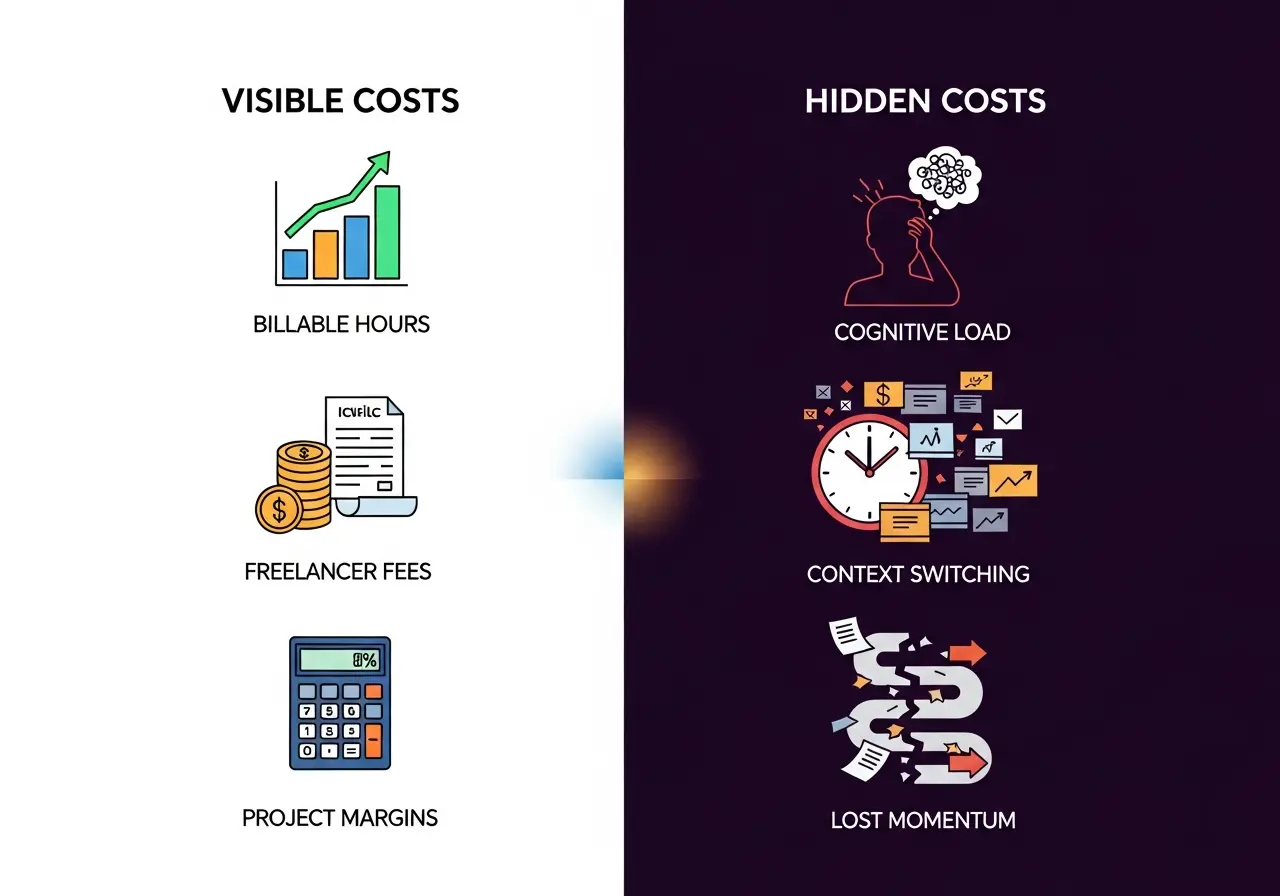
Agencies track billable hours. Freelancer fees. Project margins.
They rarely track cognitive load. Context switching. Lost momentum. Delayed initiatives. Emotional drain.
But those are real costs. And they compound faster than financial ones.
Freelancers vs. In-House vs. Systemized Agency Partners
Freelancers make sense for defined tasks. Short-term needs. Specialized skills.
In-house teams make sense for core ownership and continuity.
Systemized partners make sense when agencies need reliability, accountability, and scale without management overload.
The mistake is not using freelancers. It is an over-reliance on them where systems are required.
What High-Growth Agencies Do Differently
High-growth agencies design delivery first. They build repeatable processes. Clear ownership. Shared accountability. Documented knowledge. Performance tracking.
They reduce dependence on individuals and increase trust in systems. This is what creates consistency at scale.
How to Fix the Freelancer Problem Without Burning Everything Down
This isn’t about letting freelancers go—it’s about building a system that works. Standardize workflows, document expectations, centralize knowledge, and define ownership clearly. Use tools that create visibility and focus on measuring outcomes, not activity.
If managing this in-house feels overwhelming, you can engage a white label agency to handle these processes on your behalf, ensuring consistency, accountability, and seamless execution.
FAQs
Why do freelancers fail agencies at scale?
Freelancers are optimized for flexibility rather than system-level accountability.
Are freelancers bad for agencies?
No. They are effective for tasks. They struggle when asked to replace systems.
What hidden costs do agencies face with freelancers?
Management time, rework, onboarding fatigue, knowledge loss, delays, morale impact, and growth limitations.
When should agencies reduce freelancer dependency?
When delivery reliability, quality consistency, and scalability become priorities.
Ready to Build a Delivery System That Actually Scales
Freelancers can help you move fast. Systems help you grow safely.
At EvenDigit, our experts are fully equipped with advanced AI tools and proven delivery frameworks. We combine human expertise with process and technology to remove hidden costs and create consistency at scale. When systems replace chaos, growth accelerates with clarity and confidence.