Generative Engine Optimization vs Traditional SEO: Explaining Key Differences and Challenges


Quick Summary
- Clicks to top-ranking pages on Google SERP are reduced by 58%. That means ranking first is not enough.
- Users now prefer AI platforms like ChatGPT and Gemini to get product suggestions, answers to their specific queries, and almost everything. So, getting cited and recommended by these platforms is more important than getting too many clicks.
- GEO and SEO are not opposites. Good SEO is the foundation GEO is built on. But SEO alone isn’t enough anymore.
- But implementing GEO best practices is hard because there’s no playbook yet, no standardized tools, no clean attribution, and the platforms behave differently.

For years, traditional SEO focused on one goal: Get your page ranked high enough for users to click.
But AI-powered search changes the journey entirely. Now, AI systems are increasingly acting as the researcher, the summarizer, the recommender, and sometimes even the decision-making layer between brands and users
That means visibility is no longer only about being ranked. It is also about being cited, synthesized, recommended, and trusted by AI search engines.
Comparing Generative Engine Optimization vs traditional SEO helps you understand this new shift and best practices to dominate both Google and AI search engines.
What is Generative Engine Optimization?

Generative Engine Optimization (GEO) is the process of optimizing your content so AI tools like OpenAI ChatGPT, Google Gemini, and Perplexity AI can understand, use, and recommend it in AI-generated answers.
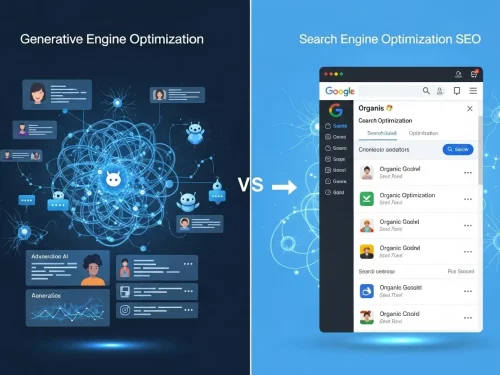
GEO Vs SEO
In traditional search, a user types a query, Google returns ten links, and the user picks one to click. Your job is to be one of those links, ideally in the top 5 position.
In AI search, the user asks a question, and the AI builds a response from dozens of sources it’s already read. Your job is to be the kind of source the AI chooses to draw from. The user may never come to your site at all.
Here’s what that looks like in practice:
| The User’s Query | What SEO Does For You | What GEO Does For You |
| “Best project management tool for remote teams” | Gets your page ranking on Google | Gets your tool recommended inside ChatGPT’s answer |
| “How does compound interest work?” | Gets your article a featured snippet | Gets your explanation paraphrased in an AI Overview |
| “Is [Your Brand] legit?” | Surfaces your review pages and About Us | Shapes how AI describes your brand in context |
| “What should I look for in a CRM?” | Drives traffic to your comparison post | Gets your criteria cited in Gemini’s response |
The click doesn’t always happen in GEO. But the influence does.
How AI Search Engines Actually Generate Answers
This is worth understanding at a basic level because it changes how you think about content. When you ask Perplexity a question, here’s roughly what happens behind the scenes:
First, it figures out what you are really asking,the intent behind the words, not just the words themselves. Then it goes out and retrieves relevant content from across the web, pulling specific chunks of text that seem most relevant to your question. Then it runs those chunks through a language model that synthesizes them into a coherent answer. Sometimes it credits the sources. Sometimes it doesn’t.
The key phrase there is “specific chunks of text.” The AI isn’t reading your entire 3,000-word article and then thinking deeply about it. It’s pulling the paragraph that most directly answers the question it’s been given.
What is Traditional SEO?

Traditional SEO is the process of optimizing your website so that search engines, primarily Google, rank your pages at the top in their results for relevant queries.
Where Traditional SEO Still Matters
- Keyword targeting: Understanding what your audience is actually searching for and building content that matches those searches with precision. This is still the foundation of a content strategy, even in the GEO era.
- Technical SEO: The structural work: crawlability, page speed, mobile performance, Core Web Vitals, structured data markup, canonical tags. If Google can’t efficiently crawl and index your site, nothing else matters. And as it turns out, good technical SEO also makes your content more accessible to AI retrieval systems.
- Backlinks: Inbound links from credible, relevant sites remain one of Google’s strongest ranking signals. This is one area where traditional SEO and GEO diverge somewhat. AI systems don’t “count” backlinks the way Google does. But backlinks still signal authority, and authority still matters.
- Content optimization: Writing content that fully addresses search intent, uses semantically related language, and matches the format the user actually wants. A how-to query wants numbered steps. A comparison query wants a table. A definitional query wants a crisp explanation up front.
- User experience: Google pays attention to how users behave on your pages. Dwell time, bounce rate, interaction signals, these all feed into how Google assesses whether your content is actually useful.
Where Traditional SEO is Fading
SEO isn’t broken. But it has real limitations that have become more visible as AI search has grown.
- The zero-click problem predates AI Overviews and has gotten worse with them. Featured snippets, knowledge panels, and AI-generated answers all reduce the need for the user to actually visit your site. You can do everything right from an SEO perspective and still see traffic decline because the answer is being served before anyone reaches your link.
- Algorithm volatility is another real issue. Core updates have become more frequent and less predictable. Brands that built solid, long-term SEO positions have seen significant drops overnight, not because their content got worse, but because Google’s interpretation of quality shifted.
- There’s the discovery gap. If your customer is researching options through an AI assistant and you have zero AI search visibility, SEO doesn’t protect you from that missed opportunity. They may never run a traditional search at all.
Generative Engine Optimization vs Traditional SEO: The Real Differences
| What We are Comparing | Traditional SEO | GEO |
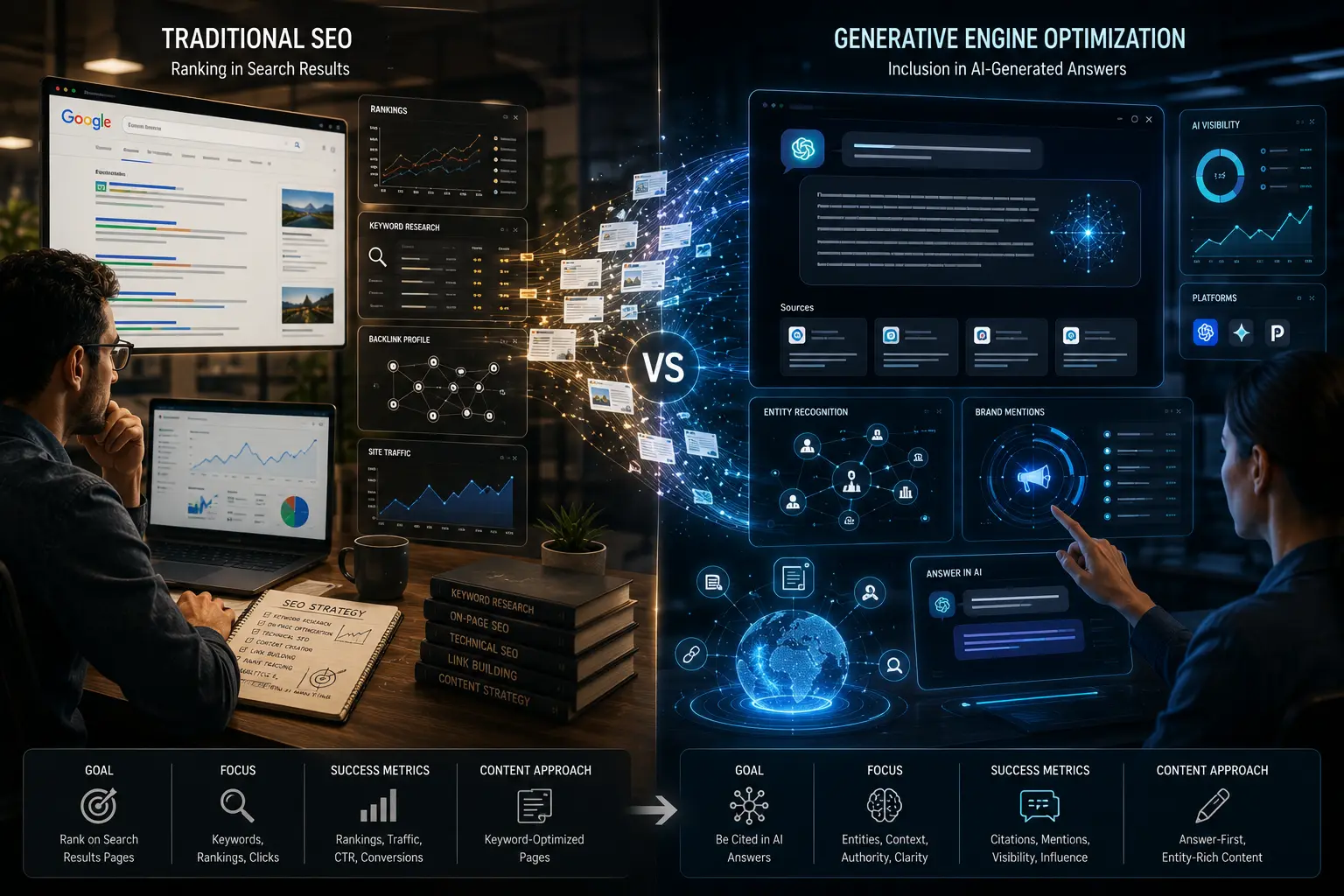
| What you are optimizing for | A spot on the results page | Inclusion in a generated answer |
| Who are you trying to impress | Google’s ranking algorithm | AI retrieval and synthesis systems |
| How success shows up | Rankings, click-through rates, traffic | Brand mentions, AI citations, answer inclusion |
| The content format that works | Keyword-optimized pages aligned to intent | Answer-first, entity-rich, conversationally structured writing |
| Where authority comes from | Backlinks and domain metrics | Topical depth, entity associations, E-E-A-T signals |
| How you measure it | Search Console, rank trackers | Manual AI prompting, emerging citation tools |
| What the user journey looks like | Search → see results → click → visit | Ask → get synthesized answer → maybe click |
| How quickly you see results | Weeks to months | Unclear — often opaque |
| Schema markup | Helps earn rich results | Helps AI systems read your content structure |
Generative Engine Optimization Vs Traditional SEO: The Difference in Content Strategy
For traditional SEO, the content strategy starts with keyword research. You find what people search for, you map content to those queries, and you optimize each piece for its target term and intent.
For GEO, content strategy starts with the questions people ask, specifically whether your content answers them in a way a machine can extract cleanly.
That’s a subtle but important difference. Keyword research is still valuable. But GEO also requires thinking about:
- What does someone genuinely need to understand to make a good decision here?
- Can a single paragraph from this article stand alone as a complete, useful answer?
- Does this content establish my brand as a genuine authority in this space, not just for this keyword, but for this entire topic area?
- Am I writing in the way people actually speak when they ask questions about this topic?
The best GEO content feels like a knowledgeable friend explaining something clearly, not a document optimized for ranking.
The Challenges of Implementing Generative Engine Optimization
Let’s not pretend this is easy. Implementing GEO comes with genuine challenges that are worth being honest about.
- You can’t measure it cleanly
This is the biggest challenge of implementing GEO. In SEO, you have Search Console. You know where you rank, for which queries, with what click-through rate. In GEO, there’s no equivalent. You are doing manual tests – typing queries into Perplexity and ChatGPT and seeing if your brand appears.
A handful of specialized tools are available, but not everyone is worth paying for. Some are early-stage and imperfect, while others are the best generative AI tools for measuring AI visibility. Without clean measurement, it’s hard to know what’s working, hard to optimize iteratively, and harder still to justify the budget internally.
- Attribution often disappears
AI systems frequently use content without crediting it. Your article might inform the structure of a Gemini answer without your brand being mentioned once. That’s influence without attribution. It matters for your customer’s decisions. It doesn’t show up in your analytics.
- Every platform behaves differently
What gets cited on Perplexity isn’t necessarily what gets cited on ChatGPT. Gemini’s relationship with traditional SEO signals is closer than Perplexity’s. Claude has different retrieval behavior depending on whether web search is enabled. There’s no single optimization target. You are essentially building for a fragmented ecosystem of AI systems with different architectures, update cycles, and source preferences.
- The traffic model is uncomfortable
SEO has always operated on a relatively direct model: rank, get traffic, convert. GEO doesn’t promise traffic. Your content can contribute substantially to an AI-generated answer and generate no visits at all. For businesses that measure marketing performance in sessions and conversions, this is a genuine tension that needs to be handled thoughtfully in reporting and strategy conversations.
- Freshness is unpredictable
AI systems have different knowledge cutoffs and retrieval behaviors. Some are pulling live content. Some are drawing from training data that’s months old. Some do both, depending on the query. This makes it genuinely hard to know when your newly published content will start influencing AI responses or whether it will at all.
- The landscape shifts fast
The GEO strategy in early 2025 looks different from the GEO strategy today. The platforms are updating their retrieval methods. New AI search products are launching. User behavior is still settling into patterns. Committing to a GEO strategy means accepting that the playbook will need to be updated more frequently than an SEO playbook.
- It cuts across teams
GEO sits at the intersection of SEO, content, PR, and brand. Your PR team may land a significant third-party mention that substantially boosts your AI visibility, but if your SEO and content teams don’t know about it, nobody connects the dots. Building an effective GEO strategy requires a level of cross-functional coordination that most organizations aren’t currently set up for.
Best GEO Practices
- Lead every section with the answer, not the wind-up. If your H2 is “What is the difference between GEO and AEO,” your first sentence should answer it directly. Not “Great question. Many marketers find themselves asking this.” Just answer it.
- Build content bodies, not content pages. One good article isn’t enough. Build interconnected clusters that cover your topic from every relevant angle. This signals topical authority in a way that single pieces can’t.
- Structure sections so they stand alone. Every major section should be readable and useful to someone who landed directly on that part of the page without reading anything above it. If understanding your H3 requires context from your H2, restructure it.
- FAQ sections belong to almost everything. Not thin FAQs with three-word answers. Full, conversational FAQ blocks that genuinely answer the questions your audience is asking, at the level of detail they need to act on.
- Use schema markup, especially the FAQPage and Article schemas. This isn’t optional anymore. It’s table stakes for giving AI systems clean signals about how your content is organized.
- Cite primary sources. Link to original research, government data, and industry reports. It signals that your claims are grounded, which increases the trust score AI systems apply to your content.
- Include original data or a genuine expert perspective. If your content says something that can’t be found elsewhere, you have given AI systems a reason to cite you specifically rather than use a more generic source.
- Be consistent in how you describe your brand across every platform. Your website, your social profiles, your press mentions, your partner pages. They should all describe what you do in a compatible language. This entity consistency is how AI systems learn what your brand is and what queries it’s relevant for.
- Test your AI visibility regularly. Spend 20 minutes a month prompting ChatGPT, Perplexity, and Gemini with the queries most relevant to your business. Note which competitors appear. Note what sources are cited. This gives you a real-world baseline to measure against, even without dedicated tooling.
- Don’t separate your SEO and GEO strategy. The same content that is technically sound, semantically thorough, and E-E-A-T compliant will perform well in traditional search and give you the strongest foundation for AI visibility. Treat them as one integrated approach, not two separate workstreams.
Will GEO Replace Traditional SEO Completely?
Straightforwardly: NO. But the relationship between the two is changing in ways that matter.
Here’s what’s actually happening. Traditional search is holding its ground on commercial intent. When someone knows what they want to buy and is looking for options, pricing, or a specific vendor, they’re still largely using traditional search or a combination of AI-assisted research that then leads to traditional search. Google’s business model depends on this category of search remaining relevant, and it’s not going away.
What AI search is taking over is the informational and research phase, the “help me understand this topic” stage that used to reliably send traffic to educational and advisory content. That traffic is increasingly being absorbed into AI-generated answers.
The net effect isn’t that SEO becomes irrelevant. It’s that the full picture of AI search visibility has expanded. You now need to appear in the SERP and in the AI response. For brands that only do one or the other, the coverage gap is a real business risk.
The trajectory is also clear. AI search platforms are improving rapidly. User adoption is growing. Voice interfaces, AI assistants, and conversational search are becoming default behaviors, especially for younger audiences.
Five years from now, the balance between traditional and AI search may look very different from today, and businesses that started adapting now will be significantly better positioned than those that waited.
The future of search is a blended ecosystem. AI handles discovery and synthesis. Traditional search handles navigation and transactions. Smart brands will be visible in both.
FAQs
What is generative engine optimization?
Generative engine optimization is the practice of structuring and writing your content so that AI-powered search engines like ChatGPT, Perplexity, Gemini, and Google AI Overviews are more likely to pull from it when generating answers.
How is GEO different from traditional SEO?
Traditional SEO gets your pages ranking on Google’s results pages. GEO gets your content cited or synthesized inside AI-generated responses. SEO is measured in rankings and traffic. GEO is measured in brand mentions, AI citations, and answer inclusion. They share foundational principles, quality content, authority, and technical soundness, but the content structure, measurement approach, and strategic targets are meaningfully different.
Is GEO replacing SEO?
No. SEO is still essential for commercial and navigational queries, and it provides the technical foundation that makes GEO possible. What’s happening is that GEO is filling a gap that SEO can’t, specifically, visibility during the AI-mediated research and discovery phase that traditional search doesn’t fully capture anymore. You need both.
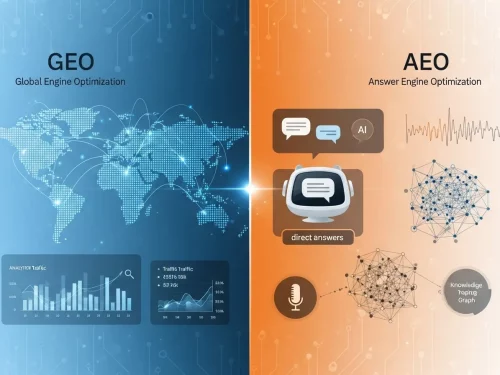
What is the difference between GEO and AEO?
Answer Engine Optimization (AEO) was an earlier term focused on earning featured snippets and direct answers within traditional Google results. GEO is a broader and more current concept that includes optimization for AI-generated responses across multiple platforms, not just Google’s on-SERP features. AEO is essentially a precursor to and a subset of GEO. Most practitioners have moved to the GEO framing because it better reflects the multi-platform, AI-native reality of search today.
Why is AI visibility important for businesses?
Because AI systems are increasingly sitting between your potential customers and your brand, especially during the research and discovery phase. If someone asks ChatGPT which vendors to consider in your category, and your brand isn’t mentioned, you may not make the shortlist. That’s a funnel leak that SEO alone can’t fix. AI visibility matters because it determines whether you’re part of the consideration set before the customer ever runs a traditional search.