
Prompt Engineering for Marketing in 2026: How to Get Better AI Results



Around 80% of marketers use AI for daily tasks such as content creation, ad campaigns, email writing, data analysis, and more. Ubdoubtedly, you must be one of them, but are you making the most out of it?
At first, it seems so. One simple prompt: “Write a short email for a sustainable fashion brand”, and it takes less than 10 seconds to generate it.
Later, you generate blogs, ads, and more in minutes. It feels like a shortcut. Then, after a few days, everything started feeling generic. A bland ad copy that does not feel useful for the target audience. A boring email that never gets opened by your audience.
You try again, change the prompts, use generic marketing AI prompts, and end up frustrated, working twice as hard as before.
Over time, AI starts feeling like more effort than help. The fault is not in AI marketing tools (whichever you are using); the fault is in your prompt. You get what you feed. Good prompt, good result. Vague prompt, vague result.
Learn prompt engineering for marketing to save your time and use AI better than other marketers. It is a practical skill that changes how useful AI actually is in your day-to-day work.
What is Prompt Engineering

Prompt engineering is nothing new to us now. It’s the way of telling AI what to do. Just as you give instructions to your juniors on how to perform a task.
However, a prompt is not just a request. It’s a detailed set of instructions on the context, goal, tone, and structure. A prompt that misses all these elements produces generic outputs, as AI has to assume everything you did not tell it.
For example, you told ChatGPT to “Write a blog on lead generation.” This prompt does not tell the model about the audience or the problem your blog is trying to solve for them. And it doesn’t matter which model or version you are using; the result won’t be good enough. Here’s the real output of this prompt.
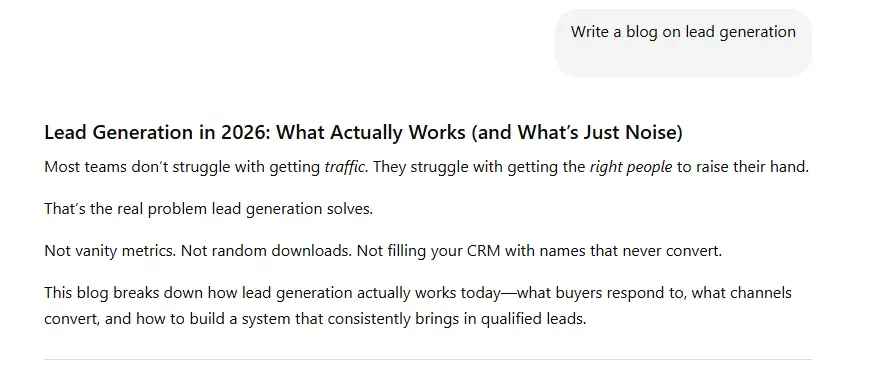
Now let’s add more context, like who the audience is, their pain points, and what they are looking for. ChatGPT understands now who is actually going to read the blog, so it writes while keeping the audience in mind, relating to their situation, and offers practical solutions, as a real writer would do. Here’s the output of this prompt.
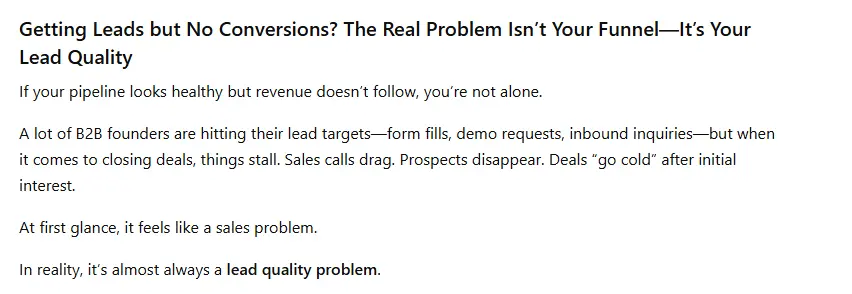
Same AI tool, but different prompt. That’s what prompt engineering can do for marketers.
How LLMs Understand Your Prompts
The first step in learning prompt engineering for marketing is understanding how LLMs work. Almost every AI model works the same; they predict because they don’t have any real-world knowledge. They check for patterns everywhere and generate output based on them. And they are creative too.
But they need more details to understand your brand, audience, requirements, and expectations. Think of an AI tool as a co-worker who is new to your business. Train it as you would train a new colleague or employee. That’s a great start to turn AI into a real marketer.
Advanced Prompting Techniques to Make AI Work For You
No two prompts give the same results. What works for other marketers might not work for you, so the common ChatGPT prompts for marketing are of less use. You only need the ones that help you get better outputs for your specific workflow.
Here are the techniques to help you create effective AI prompts for marketing tasks.
-
Chain-of-Thought Prompting
CoT helps AI think step by step before giving the final answer. Instead of jumping straight to output, it breaks down the problem and then responds. This improves clarity and depth, especially in reasoning tasks. Though highly useful for reasoning and maths, marketers can use this technique to understand strategy, write long-form blogs, and cover complex topics.
Example:
“Why is my landing page not converting?”
You ask: “Analyse why my landing page conversion might be low. Think step by step and then suggest improvements.”
ChatGPT will think of message, audience mismatch, or weak CTAs, instead of giving surface-level suggestions.
Where to use: Use this for conversion analysis, campaign performance reviews, or blog writing where explanation matters more than just information.
-
Meta Prompting
Sometimes the first output is close to your desired result, but not usable. Instead of rewriting the entire prompt, ask AI to improve its own response. In prompt engineering language, we call this technique meta prompting.
Example: “Rewrite this email to make it more engaging and remove generic phrases. Focus on clarity and a stronger call to action.”
Instead of starting again, you refine with suggestions on what to improve or where to focus. You save time with meta-prompting instead of searching for AI content prompts to write a worthy email.
Where to use: Meta prompting works best for ad copy, email campaigns, landing pages, or any content where small improvements can impact performance.
-
Generated Knowledge Prompting
AI often gives generic content because it jumps straight into writing without building context. Generated knowledge prompting helps AI build context first by searching for relevant facts or insights around the topic and then uses insights to create the final output.
Example: “List the key factors that affect email open rates. Then write a blog using those insights for SaaS marketers.”
Now, the output is based on actual points rather than assumptions. The content feels more informative and less repetitive.
Where to use: Use AI for SEO strategy and writing blogs, guides, and educational content where depth improves ranking and readability.
-
Step-Back Prompting
Often, many marketers blindly use AI prompts for marketing tasks and wonder why did they work. This technique forces the model to step back and understand the context before executing.
Example: “Before writing ad copy, explain what motivates users to click on skincare ads. Then create 3 ad variations.”
The first part builds context. The second part applies it. The output becomes more relevant.
Where to use: Useful for campaign strategy, messaging, and positioning work where clarity matters before execution.
-
Directional Stimulus Prompting
This is one of the most practical techniques. You guide the AI by telling it exactly how the output should feel, what to focus on, and what to avoid.
Example:
“Write a LinkedIn post for B2B founders. Keep it practical, avoid buzzwords, and focus on real lead generation challenges.”
Without direction, your ChatGPT output will be generic. With direction, it matches your intent.
Where to use: Use this for almost everything: social media posts, optimizing ad campaigns, blogs, and brand messaging where consistency is important.
-
ReAct Prompting
Let AI think and act. The model reasons through a task and compare options or analzye information before answering.
Example:
“Analyze 3 competitors in the CRM space. Compare their messaging and suggest how we can position differently.”
You will get a structured comparison and actionable insights instead of just descriptions.
Where to use: Competitor research, market analysis, and campaign planning where you need insights, not just content.
-
Multimodal Chain-of-Thought
You can give AI an image, creative, or visual and ask it to analyze and respond through this prompt engineering technique.
Example:
“Review this ad creative and suggest better headlines that match the visual and improve clicks.”
Where to use: Ad creatives, social media design feedback, and video or campaign ideation.
Which Technique to Ignore for Now
Some techniques like Self-Consistency and Active-Prompt are more useful in technical or research-heavy environments. They don’t add much value in daily marketing tasks like content creation, ads, or campaigns.
Why ChatGPT Prompts for Marketing Don’t Work Everytime

That’s very common problem marketers face with ChatGPT which is widely used AI. After some time the ChatGPT prompts for marketing or AI content prompts stop giving the best output.
Reason 1: It is because model gets updated
Reason 2: The prompt is too vague, long, or have too many restrictions. The model gets confused what to do and what to skip.
Reason 3: It’s memory is full. If the conversation is too long, ChatGPT will run out of memory and start giving vague outputs as before.
Reason 4: Sometime a technical glitch like interface error is also the reason for wrong output.
How to Fix
If your prompt is not working because of any of the above reasons, here’s how to fix it.
- Start the conversation in new chat
- Instead of giving one long AI content prompt, break the prompt in small tasks. For example, if writing a blog, ask AI to first do understand the audience intent, then do topic research, find relevant keywords, create blog outline, and then start writing step by step.
- Use custom instructions from the setting. Give a permanent marketing role to ChatGPT, describe the traits, context, skills, and everything you want it to remember.
- Sometimes refreshing the AI also fixes the issue.
Conclusion
AI has become the right hand of marketers for everything, from market analysis, competitor analysis, to content creation, and all. But excelling in prompt engineering for these marketing workflows is not same as using a software.
Your AI tool cannot wear multiple hats without having the deep knowledge of your brand/business. So, you should be good at explaining the context and role to the AI model. Write better and useful prompts with context, constraints, target audience, problem statement, brand goal, tone, and relevant input.
Don’t build and forget a prompt library. Refine and edit to ensure AI prompts for marketing keep working for you.
FAQs
What is prompt engineering in simple terms
It is the process of giving clear and structured instructions to AI so it produces more useful output.
Why does AI content feel generic
Because the prompt does not include enough context about the audience or the goal.
How can marketers improve prompts
By defining the audience, clarifying the task, specifying the format, and asking for examples where needed.
Does prompt engineering help with SEO
Yes, it helps create content that aligns better with search intent and user queries.
Which AI tool is better for marketing tasks
Both ChatGPT and Gemini are useful. The results depend more on how prompts are written and adapted for each tool.