
In-House Hiring vs White-Label Marketing: Save Time and Money in 2026
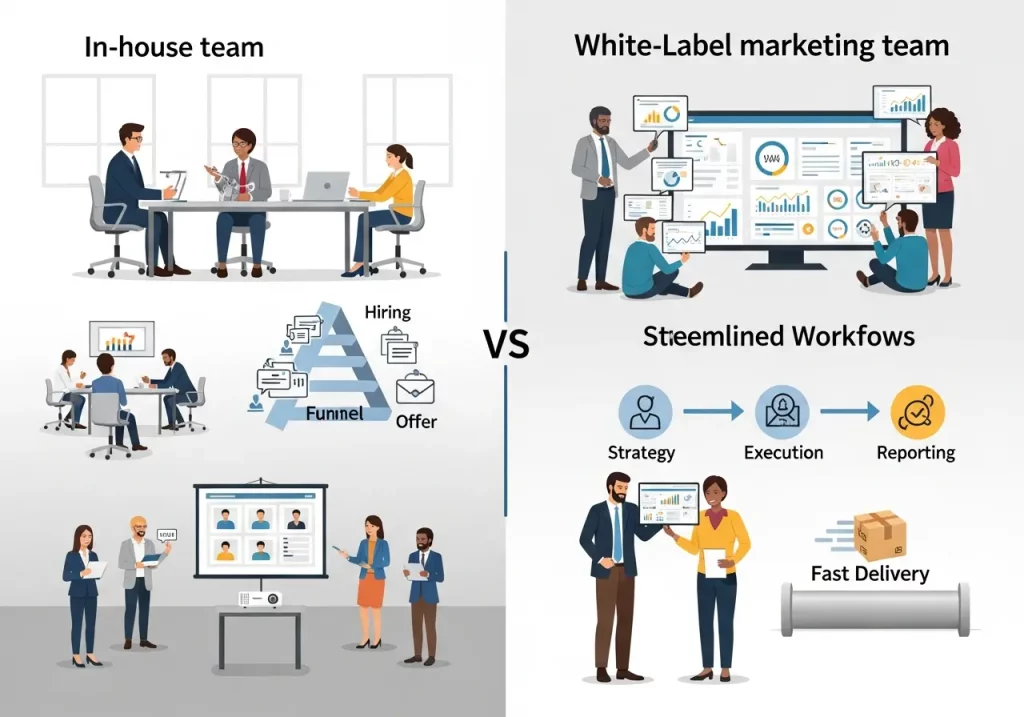
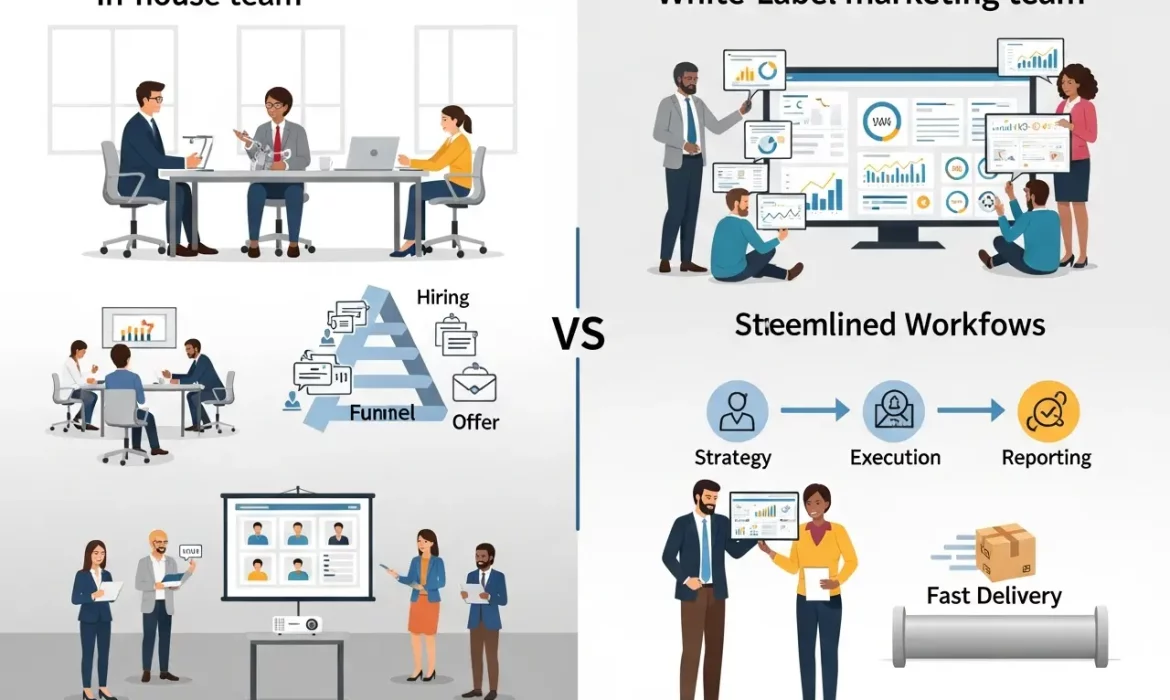
Concise Summary: As businesses scale their marketing efforts, one question keeps coming up. Should you build an in-house marketing team or partner with a white-label marketing agency? This guide breaks down the real-time, cost, scalability, and risk differences so you can make a confident, growth-ready decision.
Understanding In-House Hiring for Marketing Teams
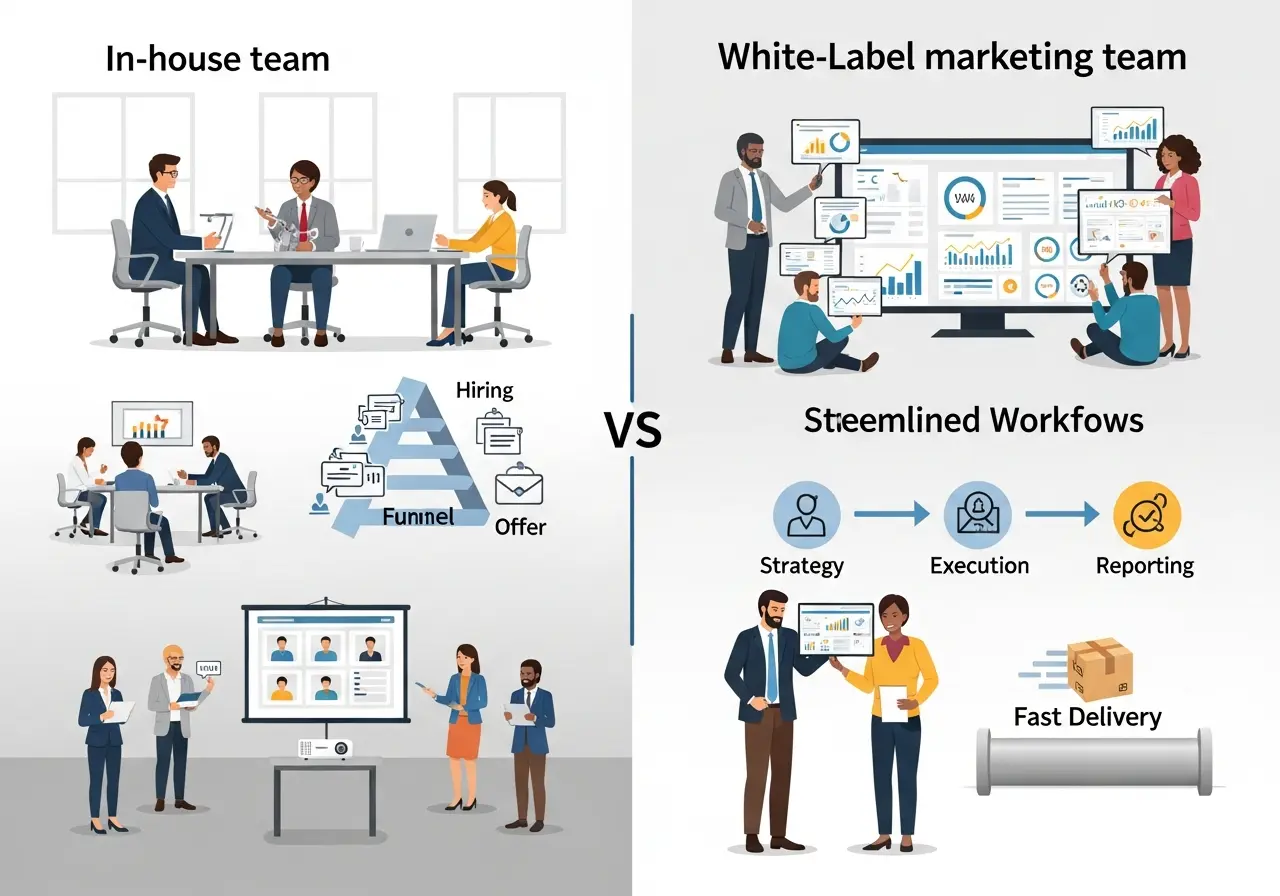
Most businesses initially lean toward in-house hiring because it feels like the most controlled and familiar approach. Having people on payroll who work exclusively on your brand appears to offer stability and ownership. However, the operational reality often looks very different once growth begins.
What In-House Hiring Really Means for Growing Businesses
In-house hiring involves recruiting full-time employees who manage strategy and execution internally. These professionals become deeply familiar with your brand, internal workflows, and company culture. Over time, they build context and institutional knowledge that external partners might take longer to develop.
That said, this model assumes consistent workloads, long-term clarity in marketing direction, and the ability to support fixed costs month after month. Many growing businesses underestimate how demanding this structure becomes once multiple channels and campaigns are running simultaneously.
Typical Roles Companies Hire In-House
To build a functional in-house marketing setup, businesses often need more than one role. A single hire rarely covers everything. Common roles include SEO specialists, paid media managers, content writers, designers, marketing managers, and analytics experts. As marketing complexity increases, so does the headcount requirement.
Each additional role brings new dependencies. Collaboration overhead increases. Decision-making slows. Leadership time shifts from strategy to people management.
Hidden Time Costs of In-House Hiring
Hiring itself is time-consuming. Recruitment cycles often take several weeks or even months. Interview rounds, skill evaluations, offer negotiations, and onboarding stretch timelines further. Once hired, employees still need ramp-up time before delivering meaningful results.
Training is another major factor. Marketing platforms evolve constantly. Teams need ongoing upskilling to stay effective. When an employee leaves, much of that invested time resets, creating continuity gaps that slow momentum.
What Is White-Label Marketing and How Does This Model Work?

White-label marketing operates on a fundamentally different model. Instead of building everything internally, businesses partner with specialized teams that deliver marketing services under the business’s brand name.
White-Label Marketing Explained in Simple Terms
A white-label marketing agency acts as an extension of your internal team. Strategy alignment, execution, reporting, and optimization are handled externally, but the output carries your brand identity. From the client or stakeholder perspective, the work appears fully in-house.
This approach allows businesses to access ready-built expertise without hiring delays or operational overhead.
Common White-Label Marketing Services Businesses Use
White-label partnerships often cover SEO, content marketing, paid search, paid social, email marketing, CRO, analytics, and even web development. Businesses choose services based on demand and scale them up or down as needed.
This modular structure makes white-label marketing especially attractive for agencies and fast-growing brands that need flexibility.
How White-Label Teams Integrate with Internal Operations
Strong white-label partners follow documented SOPs, brand guidelines, and reporting structures. Communication flows through dedicated account managers. Approval systems and dashboards ensure visibility without micromanagement.
When implemented correctly, white-label teams feel less like vendors and more like embedded specialists.
In-House Hiring vs White-Label Marketing Time Comparison
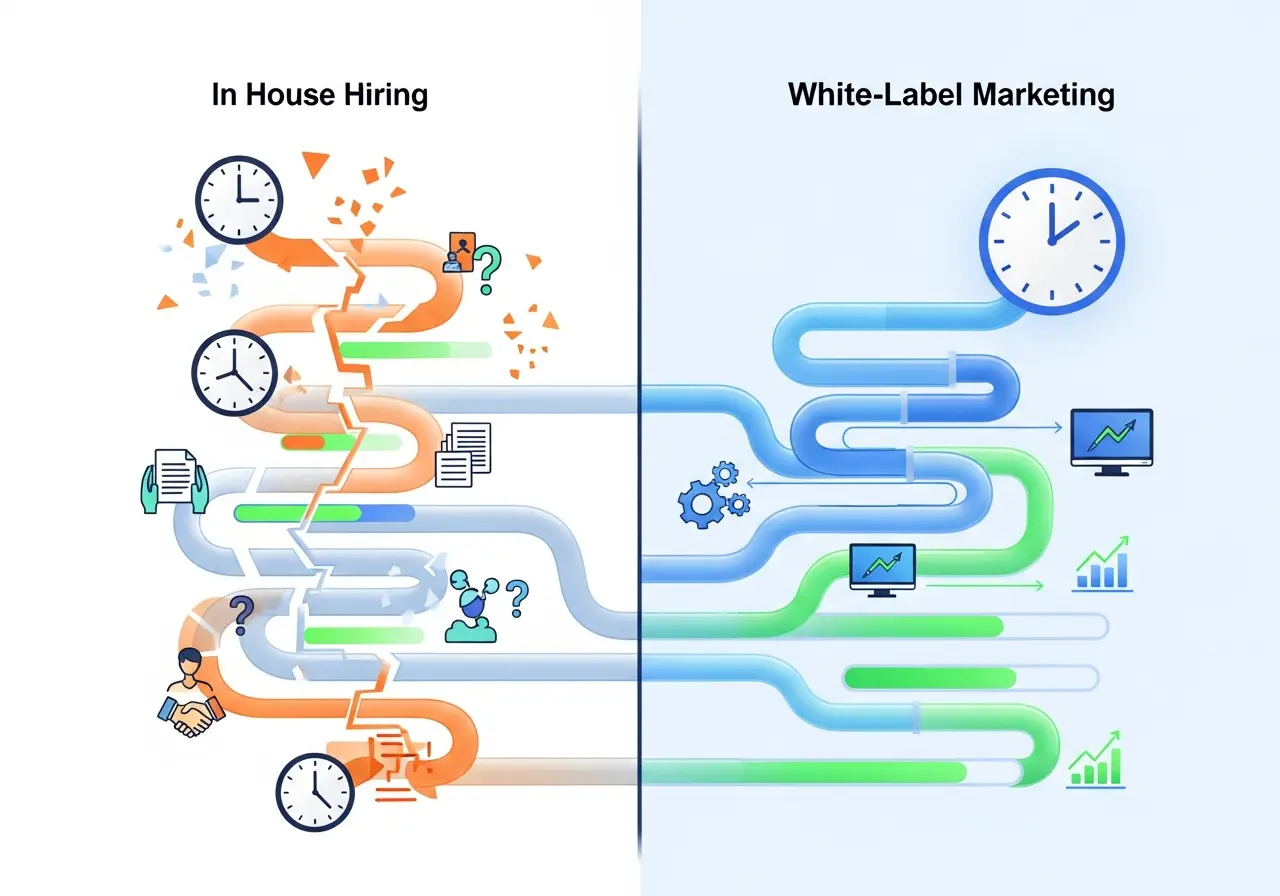
Time is one of the most underestimated growth constraints. While cost often dominates decision-making, time-to-execution usually determines success or stagnation.
Time to Get Started
In-house hiring requires planning, recruitment, onboarding, and training before campaigns even begin. White-label marketing allows businesses to start execution within days or weeks. This difference becomes critical when responding to market opportunities or client demand.
Speed of Campaign Launch and Optimization
White-label teams operate with established workflows, proven frameworks, and experienced specialists. Campaigns launch faster, and optimization cycles are shorter. In-house teams, especially smaller ones, often juggle competing priorities, which slows iteration.
Ongoing Time Drain on Leadership and Managers
Managing in-house teams requires daily oversight, performance reviews, conflict resolution, and workload balancing. White-label partnerships shift that responsibility externally. Leadership regains time to focus on growth, partnerships, and strategic direction.
Cost Comparison Between In-House Hiring and White-Label Marketing
Cost comparisons often fail because businesses focus only on salaries. The real cost picture is much broader.
Real Cost Breakdown of In-House Marketing Teams
Beyond salaries, in-house teams require benefits, office infrastructure, software licenses, recruitment fees, training budgets, and replacement costs during attrition. These expenses continue even during low-demand periods.
For most businesses, fixed marketing costs quickly exceed initial expectations.
White-Label Marketing Cost Structure Explained
White-label marketing typically operates on retainer or project-based pricing. Tools, platforms, and expertise are bundled into predictable monthly costs. There are no recruitment expenses, no training investments, and no idle payroll during slow periods.
Fixed Costs vs Variable Costs in Marketing Operations
In-house hiring locks businesses into fixed costs. White-label marketing converts those into variable expenses aligned with demand. This flexibility significantly reduces financial risk during scale-ups or downturns.
Scalability Comparison for Growing Businesses and Agencies
Scalability is where the difference between these models becomes most visible.
Scaling Challenges with In-House Marketing Teams
In-house teams scale linearly. More work requires more hires. Hiring takes time. Training takes longer. Burnout becomes a risk when demand spikes faster than capacity.
Why White-Label Marketing Enables Faster Scaling
White-label partners already have capacity. Scaling means allocating more resources, not hiring more people. New services can be added quickly without restructuring internal teams.
Handling Demand Spikes Without Operational Chaos
Seasonal campaigns, product launches, or sudden client growth often overwhelm in-house teams. White-label models absorb these spikes smoothly, maintaining delivery consistency.
Control, Quality, and Brand Consistency Comparison
Control is often cited as the main advantage of in-house hiring. In reality, control depends more on systems than location.
Control Advantages of In-House Hiring
In-house teams offer direct oversight and deep brand immersion. Decisions can be made quickly without external coordination. This is valuable for highly sensitive or proprietary initiatives.
How White-Label Marketing Maintains Quality and Consistency
Established white-label agencies operate with QA processes, standardized reporting, and performance benchmarks. Dedicated managers ensure outputs align with brand expectations.
How Businesses Can Retain Control While Using White-Label Partners
Clear SOPs, defined KPIs, approval workflows, and regular reviews preserve control while benefiting from external execution. Control shifts from task-level management to outcome-level governance.
Freelancers vs White-Label Marketing vs In-House Teams
Freelancers often appear as a middle ground but come with unique challenges.
When Freelancers Make Sense
Freelancers work well for short-term, specialized tasks or early-stage experimentation. They provide flexibility and low commitment.
Limitations of Scaling with Freelancers
As volume grows, managing multiple freelancers becomes chaotic. Availability fluctuates. Quality varies. Coordination overhead increases rapidly.
Why White-Label Agencies Replace Multiple Freelancers at Scale
White-label agencies consolidate skills, management, and accountability into one structured partnership. This reduces complexity while increasing reliability.
Why Indian White-Label Marketing Agencies Are Preferred Globally?
Indian agencies have become global white-label partners for a reason.
Talent Depth and Specialization in Indian Digital Marketing Agencies
India offers a deep pool of specialists across SEO, paid media, analytics, and content. Continuous exposure to global markets sharpens expertise.
Cost Efficiency Without Compromising Quality
Favorable cost structures allow Indian agencies to deliver enterprise-level work at competitive pricing. This creates a strong ROI for global businesses.
Time Zone Advantage for Faster Turnarounds
Time zone overlap enables near round-the-clock progress. Many agencies operate follow-the-sun delivery models, accelerating turnaround times.
How to Decide Between In-House Hiring and White-Label Marketing?
The right choice depends on growth stage and operational priorities.
Choose In-House Hiring If
Your workload is stable, your marketing needs are narrow, and brand control is mission-critical.
Choose White-Label Marketing If
You need speed, flexibility, predictable costs, and scalable execution without expanding payroll.
Common Mistakes Businesses Make When Choosing White-Label Marketing
Treating white-label services as cheap outsourcing often leads to disappointment. Skipping onboarding, unclear expectations, and weak communication structures also derail outcomes. The partnership model works best when treated as a strategic extension, not a transactional shortcut.
Ready to Scale Your Agency Without Delivery Bottlenecks?
Scaling does not have to mean hiring faster than you can manage or absorbing unnecessary risk. At EvenDigit, we work as a true white-label growth partner, helping agencies and brands expand services, improve delivery speed, and maintain quality without operational chaos.
Our experts integrate directly into your workflows, align with your brand standards, and deliver measurable outcomes across SEO, paid media, content, and performance marketing.
If you want a smarter way to scale, our team is ready to connect and explore what sustainable growth looks like for your business.
Some Frequently Asked Questions
Is white-label marketing cheaper than in-house hiring?
In most cases, yes. White-label marketing eliminates fixed salary costs, recruitment expenses, and tool investments, making it more cost-efficient at scale.
When does in-house hiring make more sense than white-label marketing?
In-house hiring works well when workloads are stable, the scope is narrow, and long-term internal ownership is essential.
Are white-label agencies reliable for long-term growth?
Yes, when chosen carefully. Established agencies with clear processes and accountability support long-term scaling effectively.
Can white-label teams match in-house quality standards?
With proper SOPs, approvals, and KPIs, white-label teams often match or exceed in-house quality.
Why do agencies prefer Indian white-label partners?
Indian agencies offer strong expertise, cost efficiency, and fast turnaround times, making them ideal scaling partners globally.