
Freelancers vs. White-Label Agency: What’s Better for Scaling Your Marketing Agency?
Scaling a marketing agency looks exciting from the outside. More clients, bigger retainers, stronger brand presence. But behind the scenes, growth often exposes cracks in delivery, team capacity, and operational stability.
Many agencies hit a point where doing more work with the same structure simply stops working. This is where the decision between freelancers and white-label agencies becomes critical.
Both models have a place. The problem starts when agencies rely on the wrong one for the stage they are in. This guide breaks down how freelancers and white-label agencies actually impact scalability, profitability, client experience, and long-term growth so you can make a decision that supports your agency’s future, not just short-term relief.
Understanding the Core Difference Between Freelancers and White-Label Agencies
At a high level, freelancers and white-label agencies both help agencies execute client work without hiring full-time staff. The similarity ends there. The way each model operates affects everything from delivery consistency to founder stress levels.
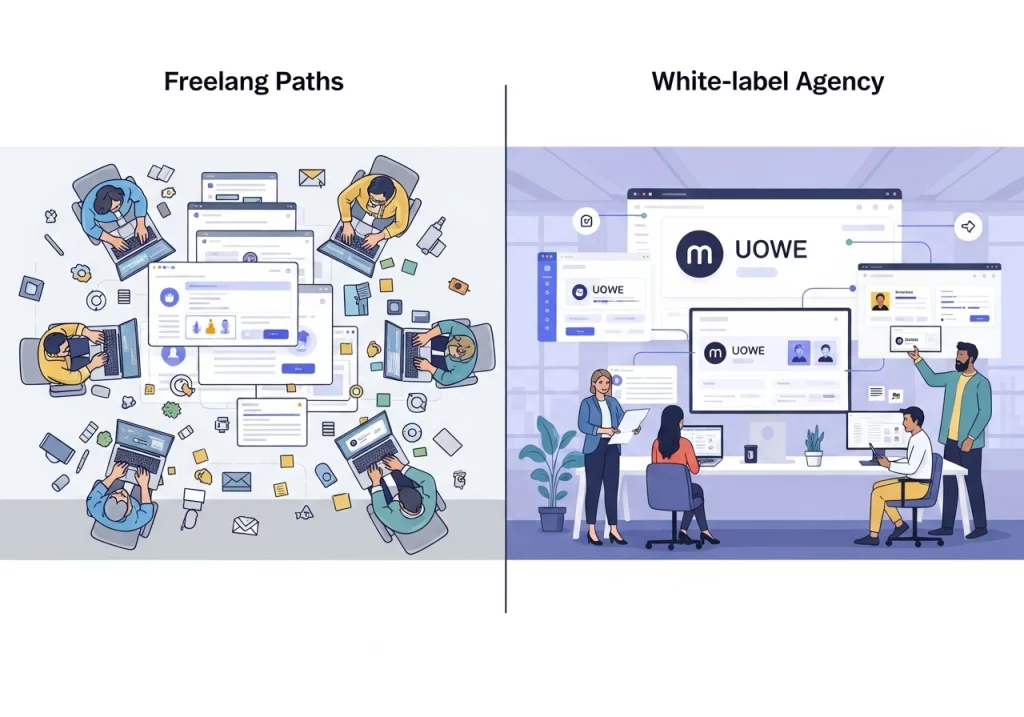
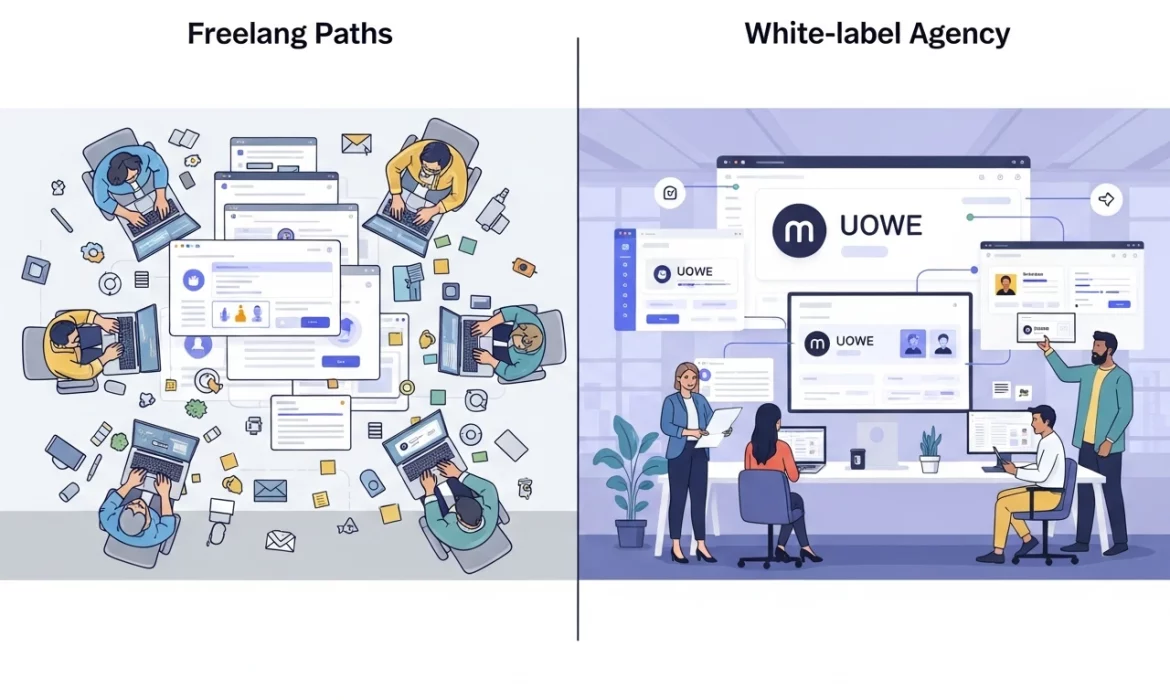
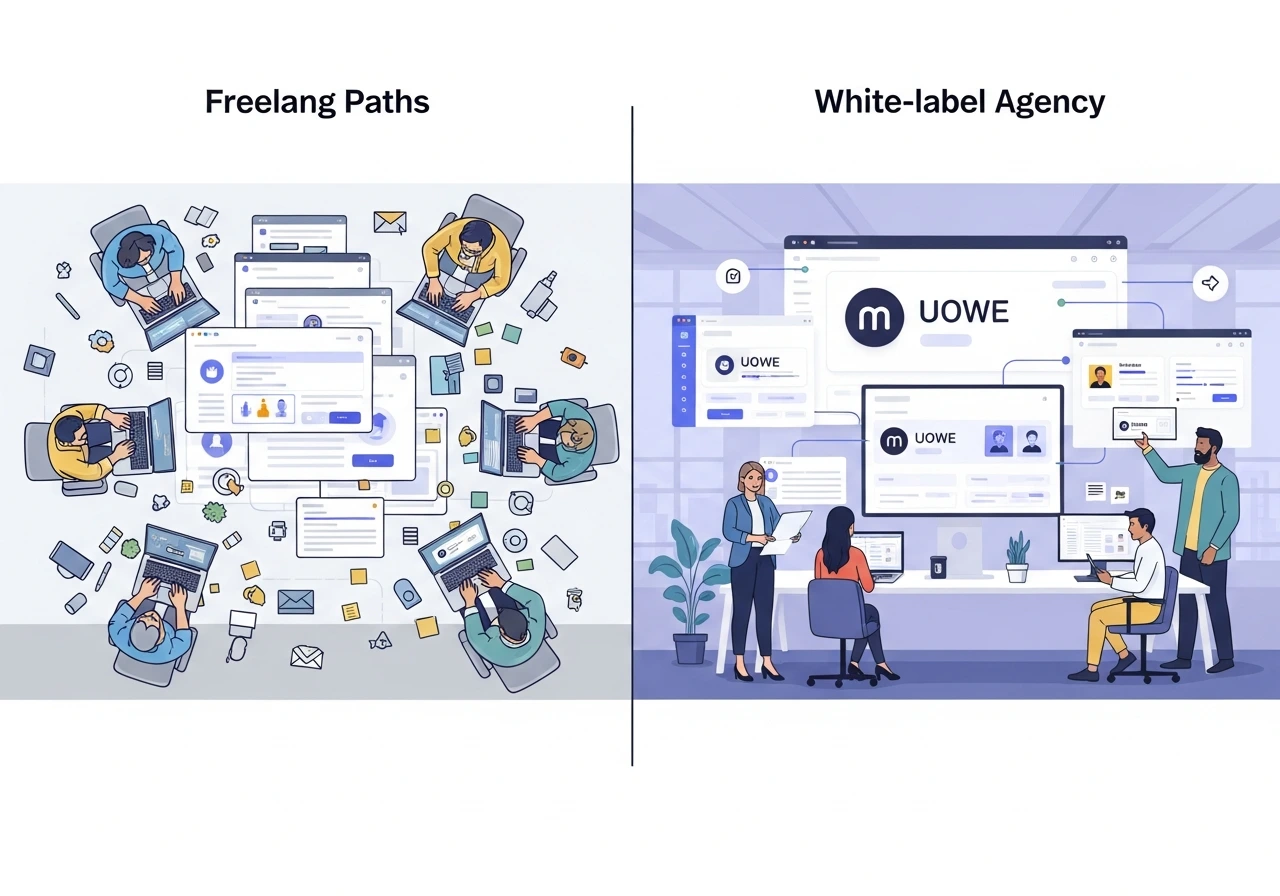
Freelancers are individual contributors. They work independently, often juggling multiple clients and commitments. White-label agencies operate as structured teams with defined processes, internal quality checks, and accountability layers. One is talent-centric. The other is system-centric. When agencies scale, systems matter far more than individual output.
What Working With Freelancers Looks Like Inside an Agency
Most agencies start with freelancers for good reasons. They are easy to hire, flexible, and usually cost less upfront. You can onboard a freelance designer, SEO specialist, or media buyer quickly and assign tasks as needed. For early-stage agencies or project-based work, this feels efficient.
Over time, however, freelancers bring complexity. Each freelancer has their own working style, availability, communication preferences, and turnaround timelines. As client volume increases, agency owners spend more time coordinating work, following up, reviewing output, and fixing inconsistencies. The agency becomes the project manager for multiple independent vendors instead of focusing on growth.
How White-Label Agencies Function as an Extension of Your Team
White-label agencies work very differently. Instead of one person handling one task, you get a delivery team that follows documented processes. Communication occurs through a single point of contact. Quality control happens internally before work reaches your clients.
From the client’s perspective, nothing changes. The work is delivered under your brand. From an operational perspective, everything changes. You stop managing individuals and start managing outcomes. This shift is what allows agencies to scale without burning out founders or account managers.
When Freelancers Make Sense for Marketing Agencies

Freelancers are not the wrong choice. They are simply the right choice only in specific scenarios. Understanding these scenarios helps agencies avoid misusing freelancers during growth phases.
Early-Stage Agencies With Limited Budgets
When an agency is just starting out, freelancers provide access to skills without long-term commitments. Cash flow is unpredictable. Client volume is low. Hiring a white-label partner at this stage may feel premature. Freelancers allow founders to test services, niches, and pricing without locking into fixed costs.
One-Off or Short-Term Client Projects
For website builds, audits, or short campaign bursts, freelancers can be efficient. There is a defined scope, a clear timeline, and limited dependency beyond delivery. Once the project ends, the relationship can pause without disruption.
Niche or Experimental Skill Requirements
Sometimes agencies need a very specific skill for a short period. This could be advanced analytics, a rare tech integration, or experimental creative work. Freelancers work well here because agencies do not need that skill consistently.
The problem arises when freelancers move from being tactical support to becoming the backbone of delivery for recurring clients.
Why White-Label Agencies Are Better for Scaling a Marketing Agency
Scaling introduces complexity. More clients mean more deadlines, more revisions, more reporting, and higher expectations. At this stage, agencies need reliability more than flexibility.
White-label agencies are designed for this phase.
Scalability Without Hiring Pressure
With a white-label partner, adding new clients does not require hiring, onboarding, or training new staff. Capacity expands as needed. This allows agencies to grow revenue without growing internal chaos.
Consistent Quality and Delivery Standards
White-label agencies operate on standardized workflows. Output quality does not fluctuate based on who is available that week. This consistency protects your brand reputation and reduces client escalations.
Reduced Management and Operational Overhead
Instead of coordinating multiple freelancers, agencies work with one delivery partner. Communication is centralized. Accountability is clear. Internal teams can focus on strategy, client relationships, and sales instead of chasing deliverables.
Faster Service Expansion Without Risk
White-label partnerships allow agencies to offer new services without internal hiring. SEO, paid media, email automation, analytics, and CRO can be added quickly. This makes upselling easier and increases average client value.
Freelancers vs White-Label Agency for Scaling
When agencies compare these two models side by side, the long-term differences become obvious.
Capacity and Growth Limits
Freelancers are limited by individual availability. When they are booked, sick, or unavailable, delivery suffers. White-label agencies operate with team redundancy, which removes single-point failure risks.
Quality Control and Accountability
Freelancers are accountable only to their own standards. White-label agencies have internal QA processes. This reduces rework and improves client satisfaction.
Client Experience and Retention
Clients care about consistency, responsiveness, and results. Missed deadlines or inconsistent output quickly erode trust. White-label agencies help agencies maintain stable delivery even as client numbers grow.
Cost Predictability and Margins
Freelancers often appear cheaper on paper. In reality, management time, rework, and client churn reduce margins. White-label pricing is predictable, which helps agencies plan margins more accurately.
Long-Term Stability and Risk
Freelancers can leave at any time. Knowledge walks out the door with them. White-label agencies provide continuity and long-term delivery support.
The Hidden Costs Agencies Ignore When Relying on Freelancers

Many agencies underestimate how expensive freelancers become at scale.
Management Time and Coordination Effort
Every freelancer requires follow-ups, reviews, clarifications, and reminders. As client volume grows, founders and managers spend more time managing people than growing the business.
Inconsistent Availability and Missed Deadlines
Freelancers prioritize their workload based on personal schedules. Your client deadlines are not always their top priority. This unpredictability creates stress and damages client trust.
Knowledge Loss and Dependency Risks
When freelancers leave, process knowledge leaves with them. Agencies are forced to retrain replacements repeatedly, slowing down delivery.
Impact on Client Trust and Retention
Clients rarely complain immediately. They quietly lose confidence and start exploring alternatives. By the time churn happens, the damage is already done.
How White-Label Partnerships Improve Agency Profitability
Profitability improves when agencies stop fighting operational fires.
Predictable Delivery Costs
White-label pricing allows agencies to forecast costs accurately. This improves pricing confidence and protects margins.
Higher Retainer Confidence
Agencies are more comfortable selling retainers when delivery capacity is secure. This stabilizes revenue and improves cash flow.
Better Resource Utilization
Internal teams focus on high-value activities like strategy, sales, and account growth instead of execution bottlenecks.
More Time for Sales and Growth
Founders move from firefighting to leadership. This is where real scale happens.
Freelancers, White-Label, or Hybrid Model? How to Decide
The best choice depends on where your agency is today.
Use Freelancers If Your Agency Is at This Stage
If you have low recurring revenue, limited clients, and mostly project-based work, freelancers may still work.
Choose a White-Label Agency If You Are Here
If you manage multiple retainers, struggle with delivery bandwidth, or want predictable growth, white-label partnerships become essential.
When a Hybrid Model Makes Strategic Sense
Many agencies use freelancers for niche work and white-label agencies for core services. This balance offers flexibility without sacrificing stability.
Common Scaling Mistakes Agencies Make
Agencies often fail not because of a lack of demand, but because of delivery breakdowns.
Scaling Sales Without Scaling Delivery
Selling faster than you can deliver leads to burnout and churn.
Over-Depending on Individual Freelancers
Single-person dependencies are fragile and risky.
Delaying Process-Driven Partnerships
Waiting too long to professionalize delivery often costs more in the long run.
Ready to Scale Your Agency Without Delivery Chaos?
Ready to Scale Your Agency Without Delivery Chaos?
At EvenDigit, we work as a white-label growth partner for agencies that want to scale without compromising delivery, quality, or client trust. Our teams integrate directly into your workflows, follow proven processes, and deliver consistently across SEO, paid media, marketing automation, analytics, and performance marketing.
Instead of juggling freelancers or rebuilding systems every time you add a client, you get a reliable extension of your agency. One point of contact. Predictable delivery. Clean reporting. And the confidence to scale retainers without operational stress.
If you are serious about growing your agency the right way, connect with EvenDigit. Our experts will understand your model, assess your delivery gaps, and help you scale with structure, not chaos.
FAQs: Freelancers vs White-Label Agencies for Scaling
Is a white-label agency better than freelancers for scaling?
Yes, for most scaling agencies. White-label agencies provide consistent delivery, built-in quality control, and scalable capacity. Freelancers are limited by individual availability and require more management as client volume grows.
When should a marketing agency stop using freelancers?
Agencies should reconsider freelancers when they manage multiple retainers, face missed deadlines, or spend excessive time coordinating delivery. At this stage, structured white-label support becomes more efficient.
Are white-label agencies more expensive than freelancers?
Not necessarily. While freelancer rates may look lower upfront, hidden costs such as rework, management time, delays, and client churn often make freelancers more expensive in the long run. White-label pricing is more predictable and margin-friendly.
Can agencies use both freelancers and white-label agencies together?
Yes. Many agencies use freelancers for niche or experimental tasks and rely on white-label agencies for core, recurring services like SEO, PPC, and marketing automation.
Do clients know when an agency uses a white-label partner?
No. White-label agencies work under your brand. Clients interact only with your agency, and all deliverables are branded as yours.
What services are best suited for white-label partnerships?
SEO, paid advertising, marketing automation, analytics, CRO, content production, and ongoing campaign management are ideal for white-label delivery due to their recurring nature and process-driven workflows.